
Zara Anderson, VP of Mining, Sintela
Tailings Storage Facilities (TSFs) rank among the largest and most complex engineering structures globally, carrying significant risk. These evolving systems expand over decades and are continuously influenced by variable loading conditions, fluctuating saturation levels, and environmental stresses.
Following the high-profile failures in recent years, the industry has shifted. The introduction of the Global Industry Standard on Tailings Management (GISTM) has moved monitoring from an operational "nice-to-have" to a board-level compliance requirement. Principle 10 of the GISTM explicitly requires operators to "implement levels of review as part of a strong quality and risk management system for all phases of the tailings facility lifecycle, including closure."
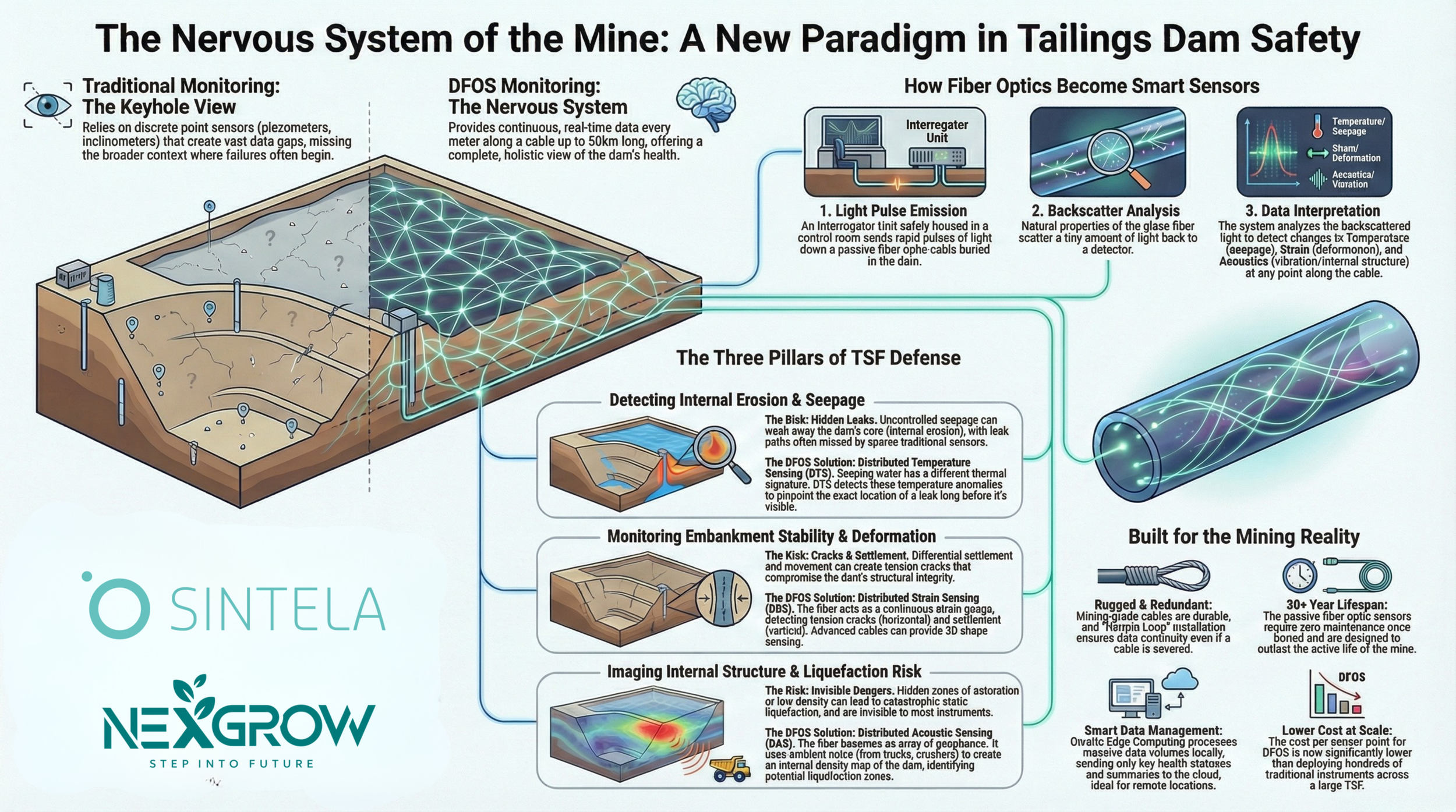
Yet, the industry’s conventional approach of relying on discrete point sensors like piezometers and inclinometers creates significant data gaps. Attempting to monitor a 5km dam with a twenty-point sensor array is like trying to see a landscape through a keyhole. You capture isolated, high-resolution data points but miss the broader context where failure often begins.
Distributed Fiber Optic Sensing (DFOS) changes this paradigm. By turning standard fiber optic cables into tens of thousands of continuous sensors, DFOS provides TSFs with a central nervous system, enabling early detection of emerging risks. It is not just a monitoring tool, but a strategic asset for GISTM compliance, insurance validation, and long-term risk resilience.
Technology Primer: How Light Becomes Data
A deep understanding of photonics is not required to appreciate the value of DFOS. Unlike traditional electronic sensors that require power (which often fail in harsh conditions), in DFOS, the sensor is simply the glass fiber itself, passive, inert, and immune to electromagnetic interference.
An Interrogator Unit (housed in a secure control room) emits rapid light pulses down the length of fiber optic cable buried in the dam. As the light travels, a small amount of light is scattered by the glass properties, degrading the pulse. The light that is scattered backwards towards the detector conveys information on the physical properties of the glass at the point of scatter. The backscatter signal can determine whether the fiber is stretched (strain), heated (temperature), or experiencing vibration (acoustics) at any point along the cable.
This allows operators to obtain readings every meter (or better) at distances exceeding 50 kilometers on a single -optical cable.
Redefining TSF Monitoring: The Three Pillars of Defense
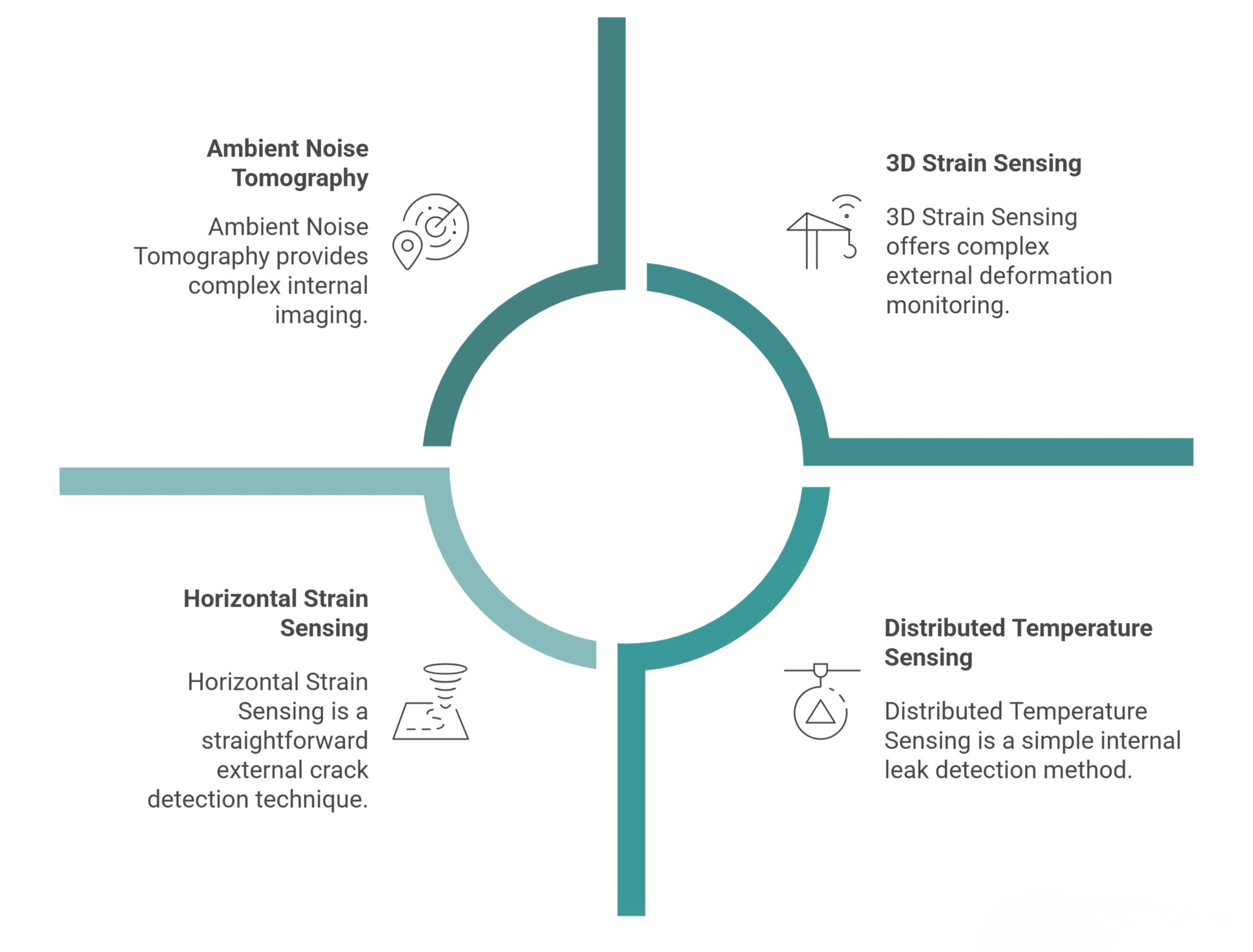
As a sophisticated technology, DFOS addresses the three critical failure modes of a tailings facility:
DFOS Solutions for Tailings Monitoring
1- Internal Erosion and Seepage Detection (DTS)
The Risk: Uncontrolled seepage leads to internal erosion (piping), washing away the dam core. Sparse array of piezometers often miss localized leak paths that thread between instruments.
The DFOS Solution: Distributed Temperature Sensing (DTS). Seepage water carries a different thermal signature than the surrounding soil. By burying fiber cables at the upstream toe or within the core, the system detects the moment temperature anomalies are caused by fluid movement. It identifies the precise location of a leak path long before visible muddy water appears on the downstream face.
2- Embankment Stability and Deformation (DSS)
The Risk: Differential settlement and shear movement create tension cracks that compromise integrity.
The DFOS Solution: Distributed Strain Sensing (DSS). The cable acts as a continuous strain gauge.
Horizontal Deployment: Cables buried in shallow trenches along the crest or lifts detect tension cracks opening.
Vertical Deployment: Cables installed in boreholes can measure vertical compression and settlement profiles.
3D Strain Capability: Advanced helical-wound or special designed cables now allow for 3D shape sensing. These specialized cables can distinguish between bending, torsion, and axial strain, enabling reconstruction of the 3D deformation of a borehole in real-time; essentially a continuous, automated inclinometer that doesn’t require manual reading.
While Shape Accel Arrays (SAAs) are excellent for high-precision measurement in single vertical boreholes, they are mechanically limited in length and expensive per meter. DFOS offers a superior alternative for perimeter coverage, monitoring strain along the entire multi-kilometer crest of a dam with a single system, rather than installing hundreds of discrete SAAs.
3- Seismic Imaging & Liquefaction Monitoring (DAS)
The Risk: Static liquefaction, hidden saturation zones or early signs of internal erosion are invisible to most traditional monitoring instruments.
The DFOS Solution: Distributed Acoustic Sensing (DAS).
Internal Imaging: DAS turns the fiber into a continuous array of geophones. By listening to ambient seismic noise (mining trucks, crushers), the system can perform Ambient Noise Tomography (ANT) to image the internal density of the dam. A sudden drop in shear wave velocity can indicate rising saturation, defects or risk of liquefaction deep inside the structure.
Flow Listening: DAS can also "hear" the acoustic turbulence of water rushing through a piping void, serving as a secondary validation for DTS seepage alerts.
Implementation: Built for the Mining Reality
A common concern among managers and operators is operational complexity. However, modern DFOS systems are engineered for rugged mining environments.

DFOS Implementation Process
Robust Installation
Mining-grade DFOS cables for embankment and tailings dams are ruggedized with HDPE jackets, water-blocking layers, and aramid strength members for tensile reinforcement. They are engineered for flexibility and durability, ensuring survival under compaction and earthworks without compromising sensing performance.
Redundancy: Best practice involves installing cables in "Hairpin Loops" (U-shape). If a cable is severed by an excavator, the interrogator can instantly measure from the other end of the loop, ensuring data continuity.
Longevity: Once buried, these passive sensors require no maintenance and are rated for 30+ years of service, outlasting the active life of most mines and usable post-closure.
Efficient Data Management
A major historical barrier was data volume. A DAS unit can generate Terabytes of data per week, while data volume for strain and temperature is significantly lower.
The Solution: More advanced systems use Edge Computing. The raw data is processed locally at the server, and only the Health Status and compressed summary datasets can be sent to the cloud. This allows TSFs in remote locations with limited satellite bandwidth to maintain real-time monitoring without overloading the network.
Cost & Scalability
The cost of interrogator units has dropped significantly over the last 5 years, while performance has doubled. A single interrogator unit can monitor many kilometers of Fiber on multiple levels. The Cost Per Sensor Point of DFOS is now significantly lower when compared to traditional instruments such as vibrating wire piezometers, SAA and Inclinometers when deployed at scale.
The Business Case: ROI & Compliance
Investing in DFOS is not just an engineering decision; it is a financial and strategic safeguard.
1. GISTM Compliance (Principle 10)
The Global Industry Standard on Tailings Management requires "Performance-Based Monitoring." DFOS provides the continuous, verifiable data trail required by the Engineer of Record (EoR) to sign off on dam safety audits. It transforms compliance from a periodic "checkbox" exercise into a continuous state of assurance.
2. Financial Resilience Focus
Stakeholders are increasingly scrutinizing TSF risks. Deploying a "Nervous System" demonstrates an innovative approach to risk management, offering measurable assurance of asset integrity, reducing perceived risk and increasing transparency.
3. Operational Efficiency
DFOS automates data collection and provides real-time assessment remotely, reducing the need for frequent site visits, manual readings, and complex data consolidation. This not only lowers labor requirements but also minimizes exposure to hazardous environments while enabling proactive maintenance instead of reactive interventions.
Conclusion: The New Standard
The industry is moving beyond point-based sensors designed to flag problems after they occur. Today’s standard demands continuous, holistic insight into structural performance, enabling proactive approach, A central nervous system.
DFOS empowers modern mining to move from fear of failure to certainty of control.
