

Strategic Safety & Critical Risk Leadership in Mining
Flagship Course · Global Mining
A practitioner-led program that takes mining professionals from hazard identification to enterprise-wide critical risk leadership, built on ICMM standards and over 80 years of real operational experience.
Built for leaders at every level of the rganisation
WHO THIS IS FOR
Whether you manage a single site or an enterprise-wide risk portfolio, this program gives you the frameworks, tools, and language to lead safety at the level your role demands.
HSE managers
Build structured risk identification and control management systems that move your operation beyond compliance.
Risk systems | Control verification | Audit readinessSite supervisors
Own and verify critical controls at the field level — understanding what failure looks like before it happens.
Field verification | Control ownership | EscalationOperational leaders
Integrate critical risk thinking into day-to-day production decisions and make safety a genuine operational advantage.
Decision-making | ALARP | TolerabilityCorporate risk teams
Establish governance structures and enterprise risk management programs aligned to ICMM and regulatory standards.
Governance | ICMM standards | Enterprise riskWHAT YOU’LL ACHIEVE
Apply structured risk identification
Use HAZID, HAZOP, FMEA, and Task Risk Assessments to uncover hazards across complex mining operations.
Master Bow-Tie methodology
Map major hazard pathways, identify prevention and mitigation controls, and communicate risk to diverse audiences.
Implement the critical control lifecycle
Assign, verify, and monitor critical controls using ICMM-aligned protocols that prevent catastrophic events.
Build organisational learning systems
Move from lagging indicators to real-time performance analytics, root cause analysis, and continuous improvement culture.
Strategic Safety Leadership for Complex Mining Systems
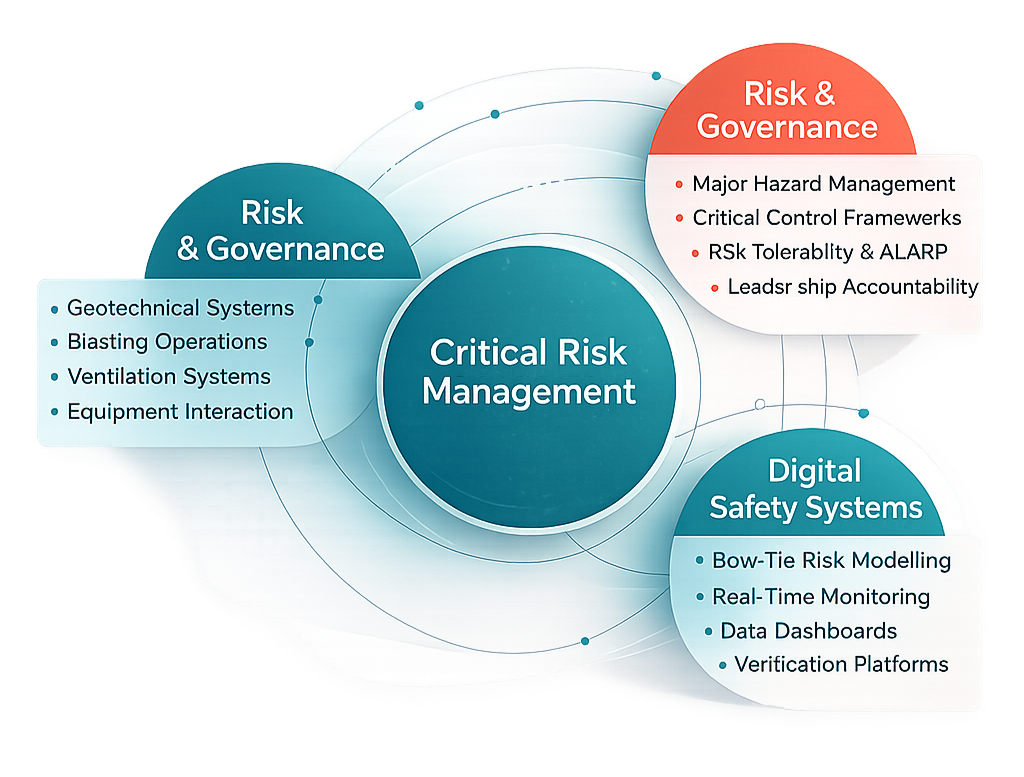
Modern mining safety is not a single discipline. It emerges from the integration of risk management, operational controls, technology, and leadership.
This program connects the systems that prevent major hazards before incidents occur.
Experience you can trust
YOUR INSTRUCTURS
This program is built on the real operational expertise of two safety leaders with decades of frontline and executive experience across global mining, construction, and nuclear operations.

Dr Carl Marx
DBA in Risk Management, MBA in Financial Management
45+ years at the intersection of human and organisational change. From mine sites to boardrooms across Africa and the globe, Dr Marx helps organisations reframe risk as a catalyst for resilient, high-performing cultures.
General Manager HSE at Konkola Copper Mines — led risk management for 13,000+ employees
Group Operational Effectiveness & HSE Manager, Saudi Arabian Mining Company
Senior Manager (Production), Anglo American

Roger Belair
Diplomas in Safety Engineering Technology, Risk Management & Management Studies
A health and safety professional with over 30 years of experience across nuclear, construction, and mining sectors globally — including operations in Canada, India, Australia, Mexico, South America, and Iceland.
Senior safety leadership at Vedanta Resources, Alcan (Rio Tinto), AECL, and SNC-Lavalin
Developer of visible felt leadership programs for large-scale site operations
Conference speaker and award recipient for safety program development
A four-phase journey from hazard to leadership
PROGRAM CURRICULUM
Each phase builds deliberately on the last — grounding learners in foundational tools before advancing to major hazard methodology, operational lifecycle management, and performance measurement.
-
Before learners can manage major hazards, they need to see them clearly. This phase introduces the full landscape of risk identification tools used by mining professionals globally — building the vocabulary and analytical capability that all subsequent phases depend on.
Topics coveredHazard identification studies in practice
Hazard and operability analysis
Failure mode and effects analysis
Likelihood vs. consequence dimensions
Risk matrix design and limitations
ALARP principle and application
Organisational risk tolerability thresholds
Regulatory risk tolerability standards
-
With foundational tools in place, learners are introduced to Bow-Tie analysis — one of the most powerful tools for understanding and communicating major hazard risk. Importantly, it is presented as one tool within a broader risk toolkit, not as a framework in itself.
Topics covered
Mapping threat pathways and top events
Prevention controls (left of the bow)
Mitigation controls (right of the bow)
Communicating risk to diverse audiences
Digital Bow-Tie software walkthrough
Bow-Tie vs. other risk tools — when to use which
-
The most powerful phase of the program. Learners follow the Critical Control Lifecycle end-to-end, aligned with ICMM documentation and best practice. Real operational case studies illustrate every step — making abstract governance frameworks immediately actionable in the field.
The 7-step lifecycleIdentify material unwanted events
Identify critical controls
Define performance requirements
Assign control ownership
Verify control effectiveness
Monitor control degradation
Implement escalation protocols
-
Safety leadership without measurement is incomplete. This phase covers how to design meaningful performance systems — shifting from lagging indicators to real-time control performance data — and how to build the organisational learning structures that drive lasting improvement.
Topics coveredLeading vs. lagging indicators
Interpreting injury rates and LTFR
Limitations of lagging safety data
Risk control performance indicators
Field verification processes
Real-time dashboards and remote monitoring
Incident investigation models
Building a continuous learning culture
Safety Insights
Practical thinking on risk and safety

Be a Leader in Responsible Tailings Management
Free pilot module available Certificate upgrade available Backed by industry pioneers
Enroll in Tailings Management: Risk & Design to build resilience, prevent failures, and shape the industry.